

Stories of compassion, love and loss: Re-presenting the AIDS epidemic
The National Archives holds an extensive collection of material related to the HIV and AIDS epidemic of the 1980s. This includes cabinet papers and records documenting the government’s response, public health campaigns, and scientific research connected to the spread and effects of the virus.
Among these, an openly accessible resource, the ‘1987 AIDS Advertising Evaluation Dataset’ aimed to capture a snapshot of the public reaction to the 1987 Public Health Campaign. While the survey retains misconceptions around the spread and impact of HIV on people at the time of creation, its raw data, whose accessibility is being explored by digital researchers at The National Archives, can unlock opportunities for research and digital storytelling.
And yet, however vast the collection, our records are only a small part of countless stories. As official documents of the state, our records rarely convey the lived experiences and emotions of people who lived (or live) with or in proximity to the virus. Our collection therefore works hand in hand with histories preserved elsewhere by voluntary groups and in community archives.
An important example of this work today, the National HIV Story Trust’s mission is to film, record and preserve the history of those affected by the AIDS pandemic of the 1980s and 90s. On 20 March 2019 at the City of London’s Guildhall, the National HIV Story Trust deposited 100 of their filmed interviews with the London Archives, amounting to more than 150 hours of material and making it the largest archival collection of its kind in the UK. The deposit represents a vast archive of first-person witness testimony: from men, women, friends, lovers, clinicians and activists as well as long term survivors themselves.
Join Researchers Giorgia Tolfo and Bernard Ogden (The National Archives) and James King (Project Manager, the National HIV Story Trust), who will be sharing more about some of the ways in which archives and communities are working to re-present the AIDS epidemic. Whether it be through re-presentations of data and digital storytelling, or the preservation of stories of compassion, love and loss. Consider how we can work together to challenge misconceptions, highlight lived experiences, and ensure that the history of HIV and AIDS isn’t being forgotten.
Sign up to more events in the Research Routes series.
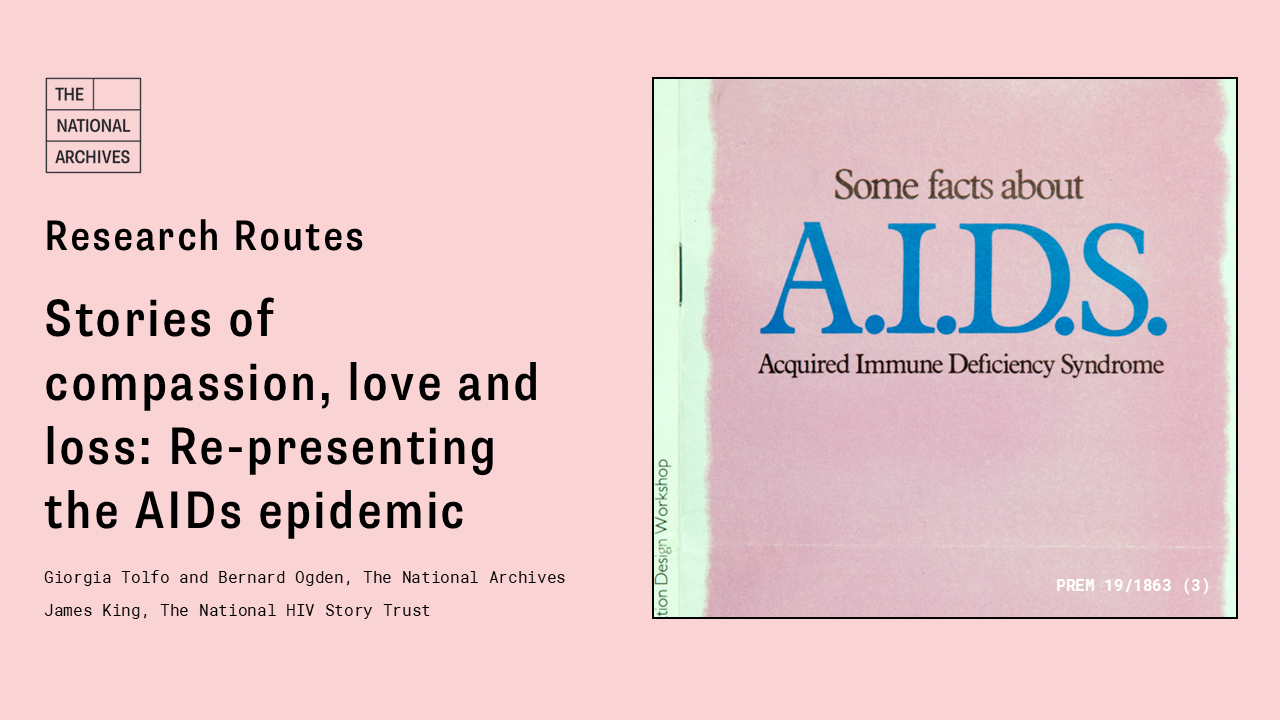
Image: Health Education Council AIDS booklet, PREM 19/1863 (3), 1985.
HOW TO WATCH
This event will be presented on Zoom. You do not need a Zoom account to join an event, and can join from your browser from a laptop or mobile device. For the best experience we recommend using either a laptop or desktop computer.
All communications for the event will be sent to you via email from Eventbrite.
You will receive a reminder email including a link to join in advance of the event. Please ensure you enter the correct email when signing up and check your spam if you have not received the email the day before the event.
You can also access the Zoom webinar stream via the ‘Access Link’ above. This event will be recorded and uploaded to our YouTube channel at a later date.
Date
- 10 Mar 2026
- Expired!
Time
- 1:00 pm - 2:00 pm
Location

Organizer
-
The National Archives: for academic and research communities
-
Website
https://www.eventbrite.co.uk/o/the-national-archives-for-academic-and-research-communities-8627521843